How to Make an Upload Script That Renames Files to Numbers
On Windows 10, changing the proper name of one file is easy. The problem is when you have to rename many files in a specific binder.
If you have to rename a long list of files, you lot tin speed up the process using File Explorer, PowerShell, Command Prompt, and even the Microsoft PowerToys app.
In this Windows 10 guide, nosotros will walk you through several different means to bulk rename files, including changing the extension.
- How to rename multiple files using File Explorer
- How to rename multiple files using Command Prompt
- How to rename multiple files using PowerShell
- How to rename multiple files using PowerToys
How to rename multiple files using File Explorer
The easiest way to rename one or multiple files on Windows 10 is past using File Explorer.
Rename multiple files 1 at a time
To rename multiple files with the "Tab" central, use these steps:
-
Open File Explorer.
Quick tip: Yous can apace open File Explorer with the icon in the taskbar, the Windows key + E keyboard shortcut, or by clicking the File Explorer icon from the left pane in the Commencement carte du jour.
- Navigate to the folder with the files to rename.
- Click the View tab.
-
Select the Details view.
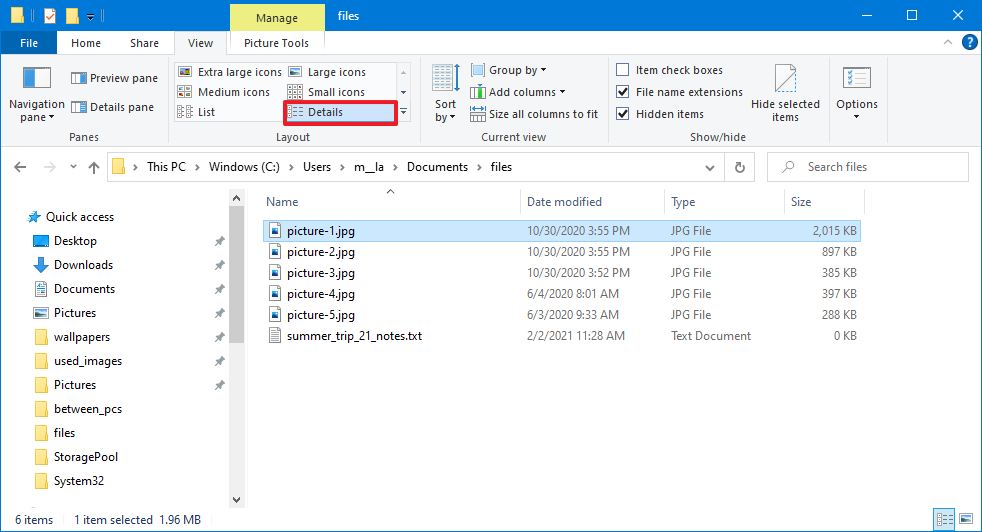 Source: Windows Primal
 - Select the commencement file in the folder.
- Click the Home tab.
-
Click the Rename button.
 Source: Windows Cardinal
 Quick tip: Alternatively, yous tin can printing the F2 push button. Right-click the file and select the Rename pick from the context menu. Or you tin click the file once and slowly click the proper name again to trigger the rename action.
- Confirm a new name for the file.
- Press the Tab key to leap and trigger the rename action for the side by side file down the list.
- Confirm the new file name.
-
Press the Tab key again to leap and trigger the side by side rename.
Quick tip: You can go along pressing the Tab key to skip the file and continue renaming other files.
- Go along repeating steps 9 and 10 to rename all the files.


Once you consummate these steps, continue pressing the "Tab" key to go along renaming files in the location.
Rename multiple files at once
To rename multiple files in bulk with the aforementioned name structure on Windows x, employ these steps:
- Open File Explorer.
- Navigate to the folder with the files to change their names.
- Click the View tab.
-
Select the Details view.
Source: Windows Central - Click the Habitation tab.
-
Click the Select all push.
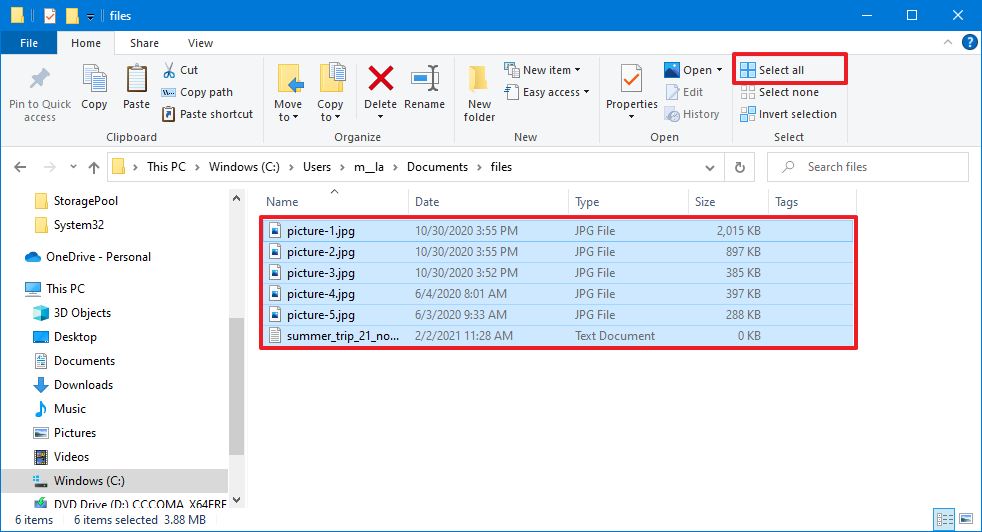 Source: Windows Central
 Quick tip: Alternatively, you lot tin can also use the Ctrl + A keyboard shortcut to select all files. You lot can printing and hold the Ctrl key and then click each file to rename. Or you can choose the first file, press and agree the Shift cardinal, and so click the terminal file to select a group.
- Click the Rename button from the "Home" tab.
-
Ostend the new file name base of operations and printing Enter.
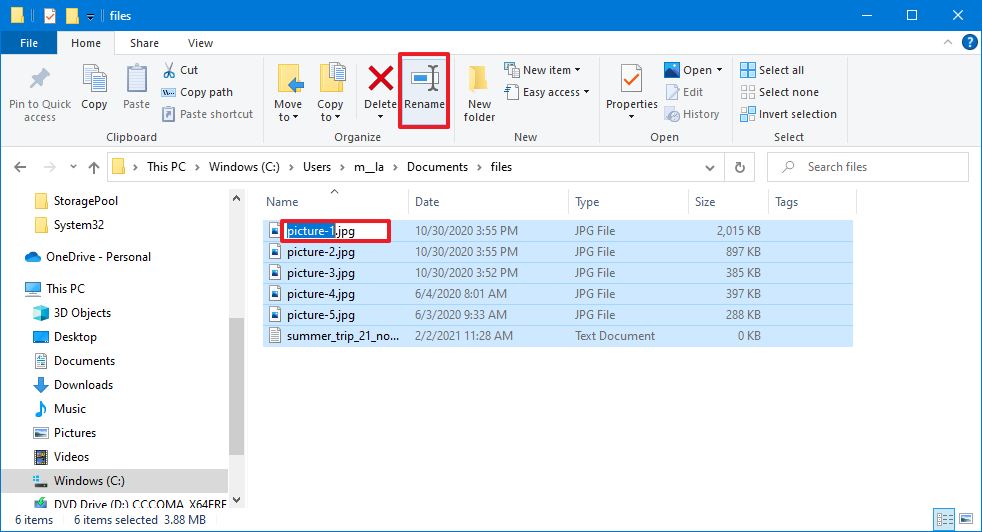 Source: Windows Central


Subsequently you consummate the steps, the selected files will be renamed using the same naming construction you specified with a count number in parentheses to make each file name different. For instance, summer_trip_2022 (1).jpg and summer_trip_2022 (2).jpg.
You could employ the Ctrl + Z keyboard shortcut to undo the changes if you made a mistake. Or you can click the menu button from the title bar and select the Undo push button.
How to rename multiple files using Command Prompt
Command Prompt also offers multiple ways to change the name of multiple files in bulk on Windows ten.
Rename single file
To rename i file with Command Prompt on Windows 10, use these steps:
- Open Starting time.
- Search for Command Prompt and click the top consequence to open the app.
-
Type the following control case to navigate to the folder with the files to rename and press Enter:
cd c:\PATH\TO\FILESFor instance, this example opens the "files" binder within "Documents":
cd %USERPROFILE%\Documents\files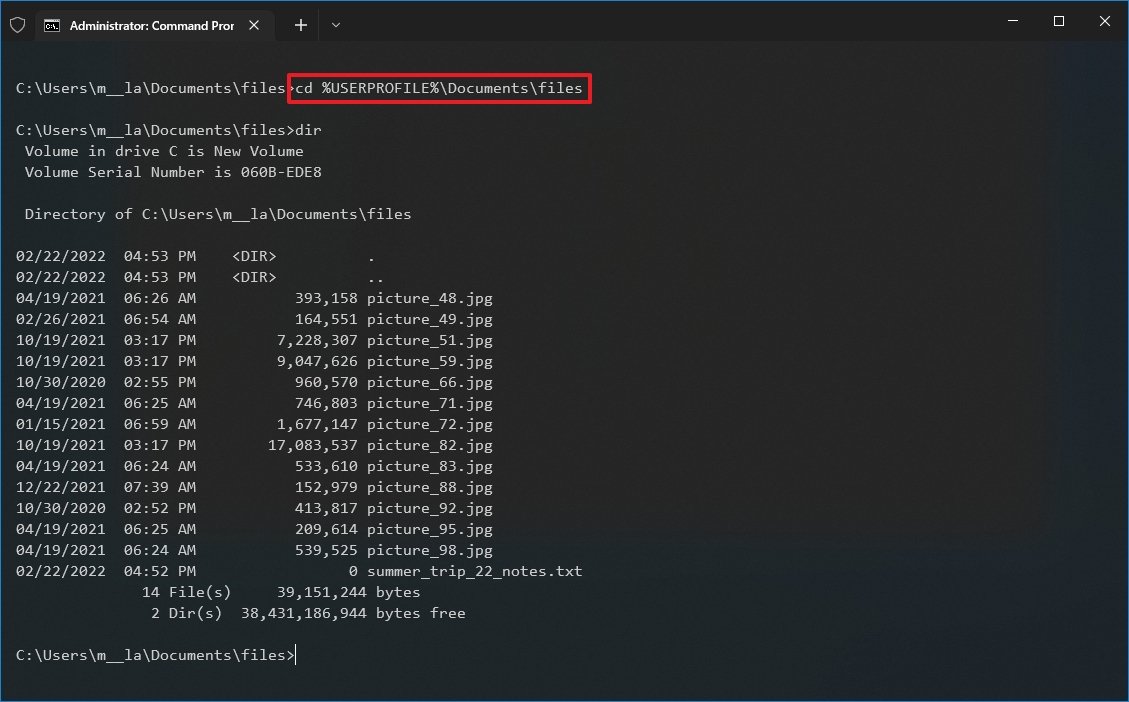 Source: Windows Central
 -
Type the following control to view the files in the location and press Enter:
dir -
Blazon the following command to rename the file and press Enter:
ren "OLD-FILENAME.EXTENSION" "NEW-FILENAME.EXTENSION"In the command, replace "Former-FILENAME.EXTENSION" and "NEW-FILENAME.EXTENSION" with the old and new file names. The quotation marks are merely necessary if the title includes spaces.
For instance, this command renames the file to "summer_trip_22_notes.txt":
ren summer_trip_22_notes.txt summer_vacation_22_notes.txt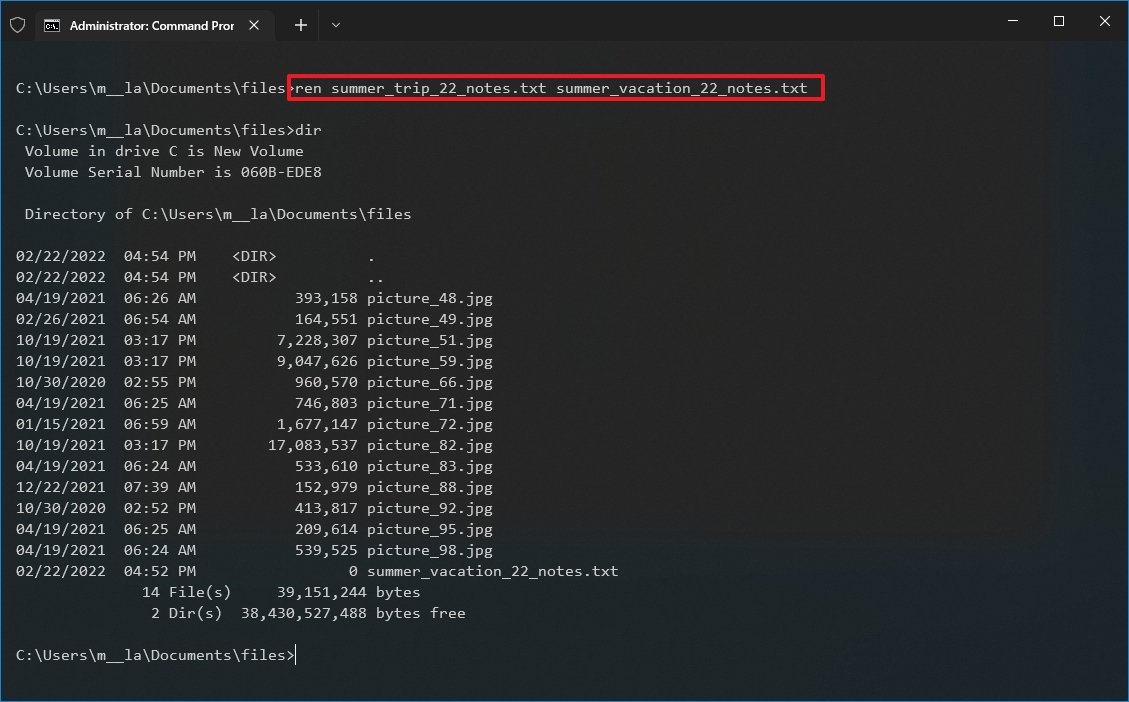 Source: Windows Central
 - Repeat step 5 to alter the name of the remaining files.


Once you lot complete these steps, Control Prompt will rename the file with the new name available in the command.
Rename multiple files
To rename multiple files in bulk with the same proper name structure with Command Prompt, utilise these steps:
- Open Start.
- Search for Command Prompt and click the top result to open the app.
-
Blazon the post-obit control example to navigate to the folder with the files to rename and printing Enter:
cd c:\PATH\TO\FILESFor example, this example opens the "files" binder inside "Documents":
cd %USERPROFILE%\Documents\files -
(Optional) Type the following command to view the files in the location and press Enter:
dir -
Blazon the post-obit command to rename the files in bulk and press Enter:
ren *.FILE-EXTENSION ???-FILE-Proper noun.*In the command, supervene upon "FILE-EXTENSION" with the extension to change and "FILE-NAME" with function of the name to add to the files. The asterisk
*is a wildcard that tells the ren command to rename everything with a specific extension. The question marking?is also a wildcard, but information technology represents a graphic symbol of the original name you desire to go on every bit part of the new proper noun.For case, this command renames all ".jpg" files leaving the first 3 characters (which works as a unique identifier to avoid duplication) and appends "-hikingTrails" to the name:
ren *.jpg ???-hikingTrip.*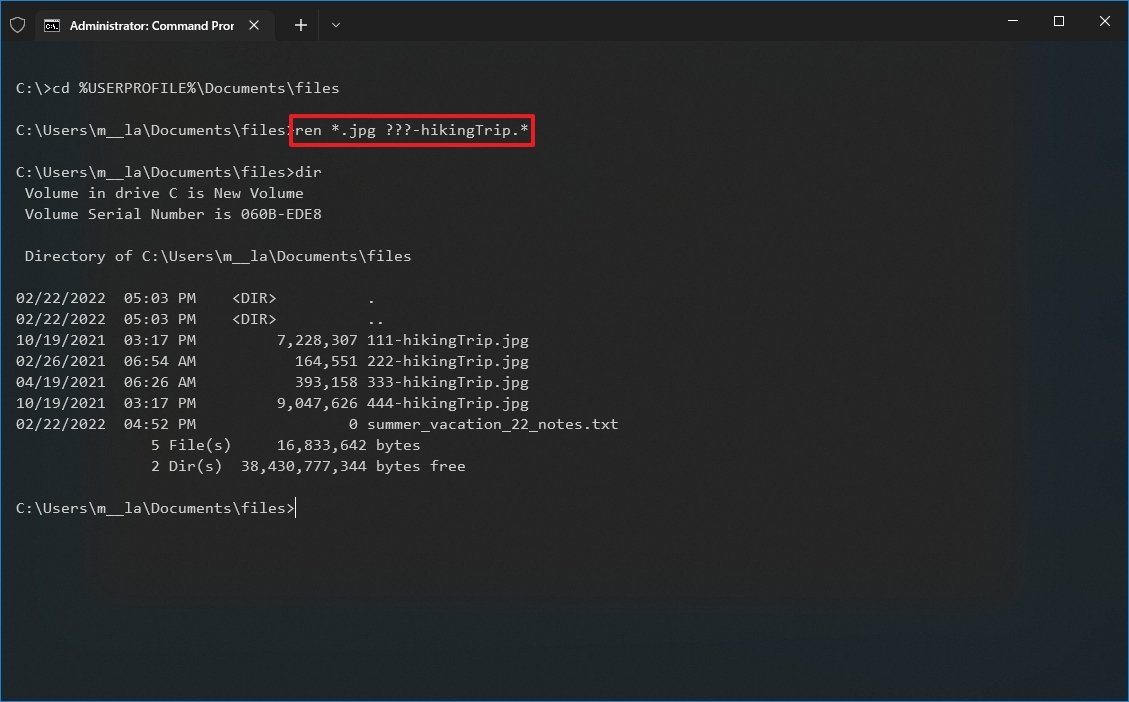 Source: Windows Cardinal
 Quick tip: When renaming files, the ren command sees a menses (.) as the end of the filename. This ways that if you accept files with a menses equally office of the proper name, the control may produce unexpected results.

After y'all complete the steps, the files will be renamed using the settings you specified.
Trim multiple file names
To make file names shorter with Command Prompt on Windows 10, use these steps:
- Open Start.
- Search for Command Prompt and click the peak result to open the app.
-
Type the following command example to navigate to the folder with the files to rename and press Enter:
cd c:\PATH\TO\FILESThis instance opens the "files" folder inside "Documents":
cd %USERPROFILE%\Documents\files -
(Optional) Type the following command to view the files in the location and printing Enter:
dir -
Type the following command to make file names shorter and press Enter:
ren *.* ?????.*In the command, the asterisk
*matches all the file names and extensions in the folder, and the question marks?betoken how many characters to utilize for the new file proper noun.For instance, this command trims the file names longer than 5 characters:
ren *.* ?????.*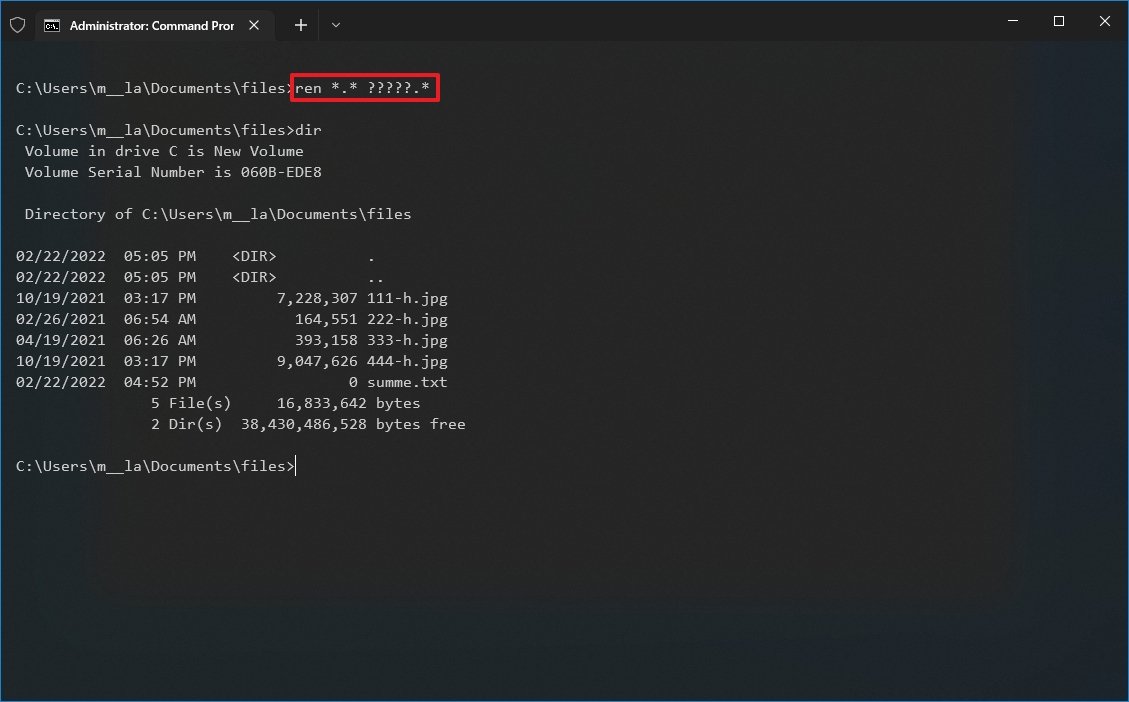 Source: Windows Key
 Quick note: If the file proper name has fewer than five characters, the name will not change. (If you want to make the file proper noun longer, add extra question marks in the syntax.)

Once you complete these steps, you will have shorter file names, depending on the question marks (?) bachelor in the command.
Modify multiple file names
To rename function of the proper name on similar files on Windows 10, utilize these steps:
- Open Start.
- Search for Control Prompt and click the top event to open the app.
-
Type the following command instance to navigate to the folder with the files to rename and press Enter:
cd c:\PATH\TO\FILESThis example opens the "files" binder within "Documents":
cd %USERPROFILE%\Documents\files -
(Optional) Type the following command to view the files in the location and printing Enter:
dir -
Blazon the post-obit control to rename the part of the file name and press Enter:
ren OLD-FILE-NAME-Role*.* NEW-FILENAME-Role*.*In the command, supersede "Onetime-FILE-Proper name-PART" and "NEW-FILENAME-Role" with the old and new parts of the filename. The asterisk
*is a wildcard that will lucifer the rest of the filename and file extension to append the new part of the name.For case, this command renames files that start with "summer_trip_22" to "vacation_2022":
ren summer_trip_22*.* vacation_2022*.*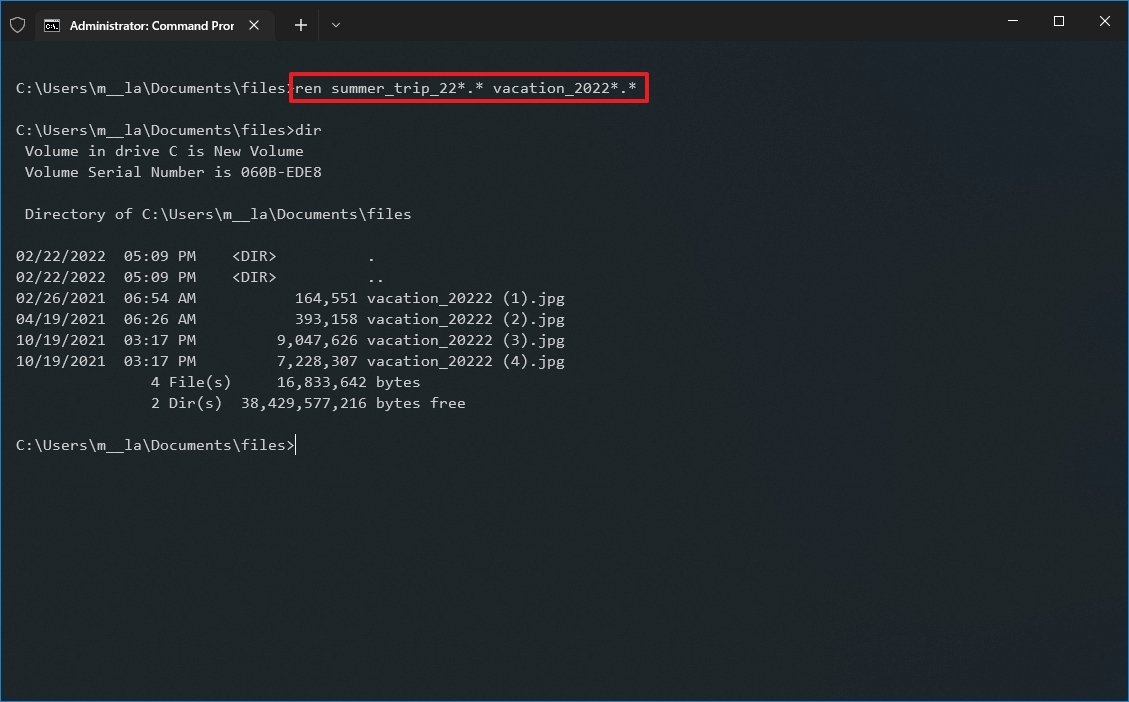 Source: Windows Central

After you consummate the steps, the control volition modify those files similar to the new name structure bachelor in the command.
Modify file extension
To change the file extension to another, use these steps:
- Open Start.
- Search for Command Prompt and click the top result to open the app.
-
Type the following command example to navigate to the folder with the files you want to rename and press Enter:
cd c:\PATH\TO\FILESThis example opens the "files" folder within "Documents":
cd %USERPROFILE%\Documents\files -
(Optional) Type the following command to view a listing of the files in the location and printing Enter:
dir -
Type the following command to change the file extension and press Enter:
ren *.OLD-EXTENSION *.NEW-EXTENSIONIn the command, change "OLD-EXTENSION" and "NEW-EXTENSION" with the erstwhile and new file extension.
For case, this command changes the extension from ".txt" to ".doctor" uniform with Microsoft Give-and-take for the files in the location:
ren *.txt *.dr.This example without wildcards (
*) changes the only extension of a single file from ".txt" to ".md":ren vacation_2022_notes.txt vacation_2022_notes.doc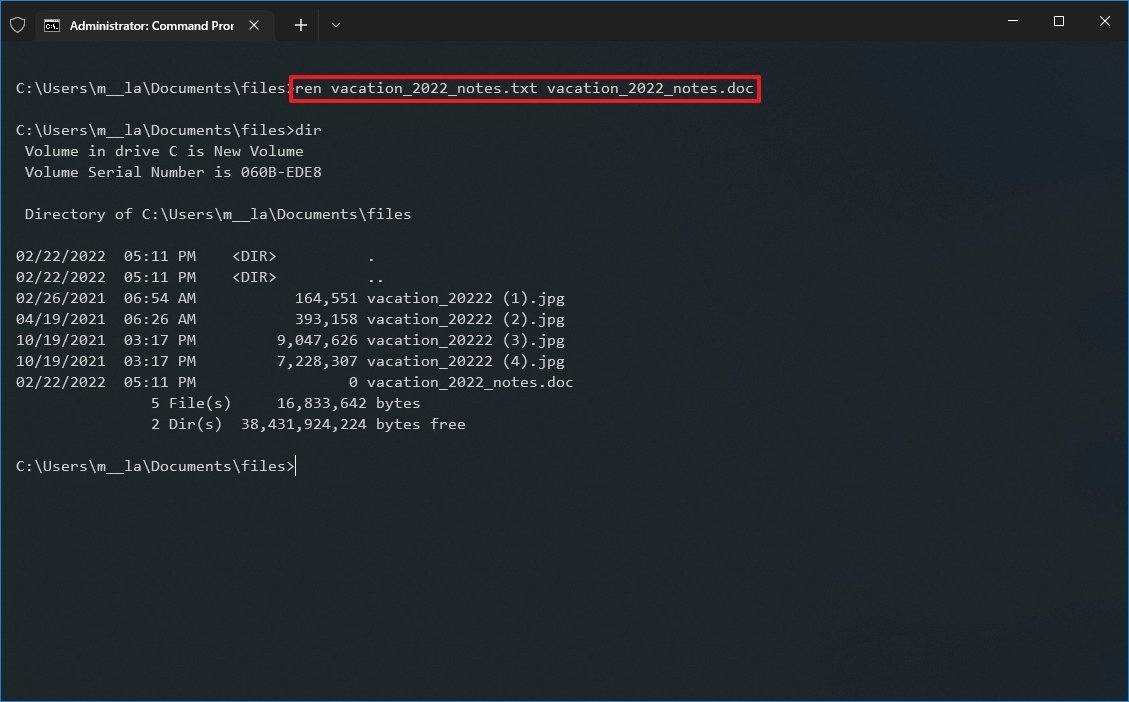 Source: Windows Central

Once you complete the steps, the file extension volition be replaced with the new extension in the command.
Rename files with specific extension
The previous steps rename every file inside the location. Nonetheless, if you want to rename only a group of files with a specific format, you must omit the asterisk * and specify the command's target extension.
To rename files with a specific file extension with Control Prompt, apply these steps:
- Open Start.
- Search for Control Prompt and click the elevation result to open the app.
-
Type the following command case to navigate to the folder with the files to rename and press Enter:
cd c:\PATH\TO\FILESThis example opens the "files" folder inside "Documents":
cd %USERPROFILE%\Documents\files -
(Optional) Blazon the following command to view the files in the location and press Enter:
dir -
Type the post-obit command to change the file extension in the location and press Enter:
ren Former-FILE-Proper noun*.EXTENSION NEW-FILE-NAME*.EXTENSIONIn the command, change "Old-FILE-NAME," "NEW-FILE-Proper noun," and "EXTENSION" with the sometime and new file name and extension.
For instance, this command but renames images with a ".jpg" extension:
ren flick-*.jpg vacation*.jpg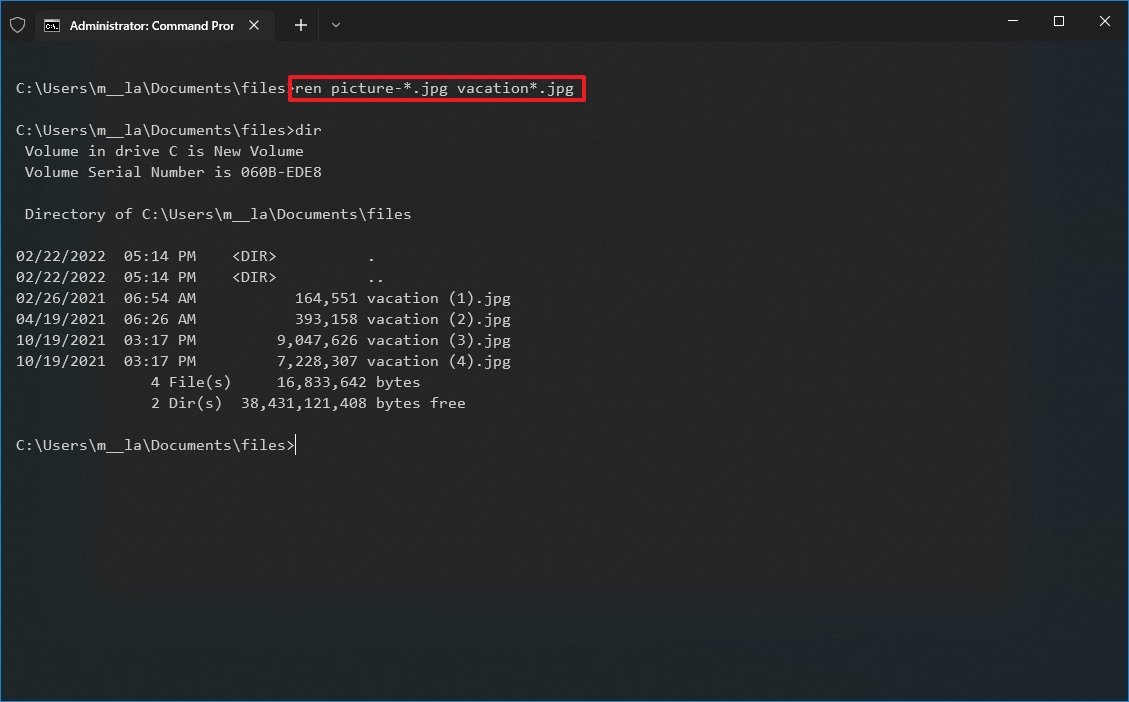 Source: Windows Central

After y'all complete the steps, Command Prompt will rename the files using the options you specified in the command.
How to rename multiple files using PowerShell
You tin can likewise apply PowerShell to rename multiple files on Windows x. Although using this tool, there are many ways to manipulate files, the instructions in this guide are only meant to go started with the nigh common scenarios.
Rename single file
To rename simply one file with a PowerShell command, use these steps:
- Open Start.
- Search for PowerShell and click the top outcome to open the app.
-
Type the post-obit control example to navigate the binder with the files to rename and printing Enter:
cd PATH\TO\FOLDERIn the command, replace
PATH\TO\Folderwith the actual path to the location.For instance, this control navigates the "files" binder inside "Documents":
cd C:\Users\USERNAME\Documents\files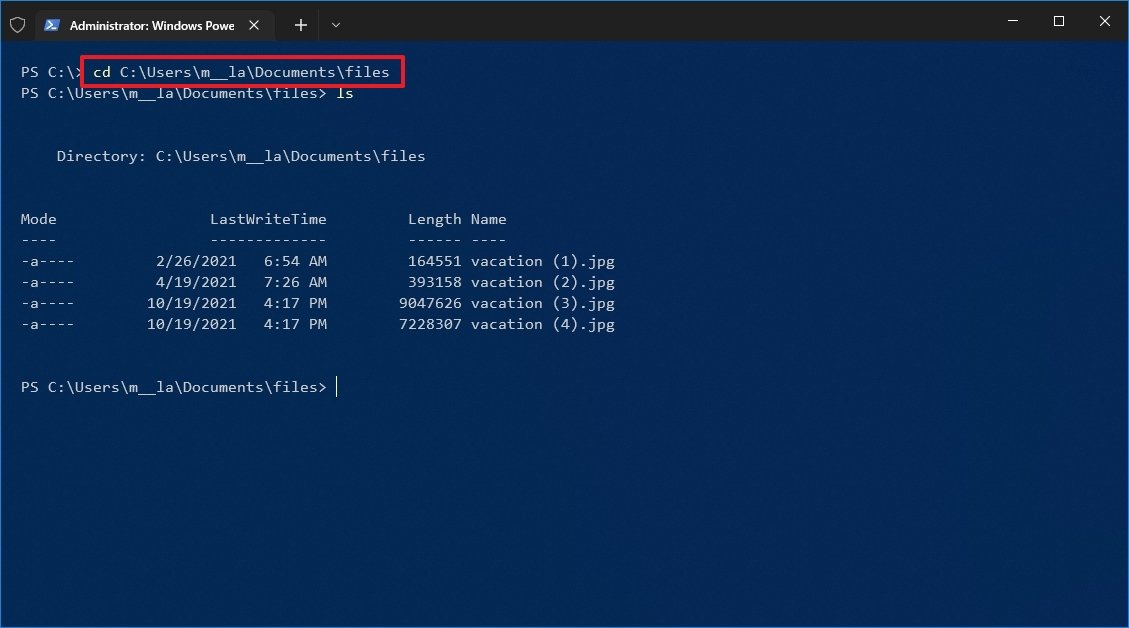 Source: Windows Central
 -
(Optional) Type the post-obit control to view the files in the location and press Enter:
ls -
Type the following command to change the proper noun of a single file and press Enter:
Rename-Item "Sometime-FILE-Proper noun.EXTENSION" "NEW-FILE-NAME.EXTENSION"In the command, specify the old and new file name and extension. The quotation marks are only required if the name includes spaces.
For instance, this command renames the file to "hiking_trip_2022_notes.txt":
Rename-Item summer_trip_22_notes.txt hiking_trip_2022_notes.txt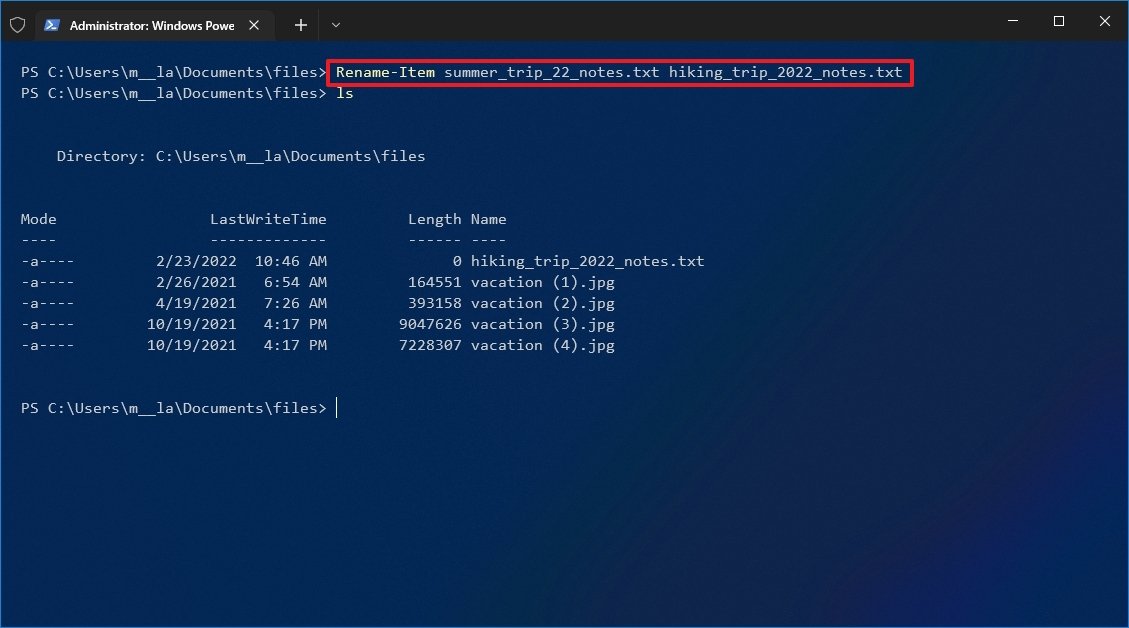 Source: Windows Central
 - Echo step 5 to go along renaming other files.


Once y'all complete the steps, the control volition change the file's name you specified.
Rename multiple files in bulk
To rename multiple files in bulk, when the name structure is non of import, use these steps:
- Open First.
- Search for PowerShell and click the summit result to open the app.
-
Blazon the following command instance to navigate to the folder with the files to rename and press Enter:
cd PATH\TO\BinderIn the control, replace
PATH\TO\Binderwith the bodily path to the location.For case, this control navigates the "files" folder inside "Documents":
cd C:\Users\USERNAME\Documents\files -
(Optional) Type the following command to view a list of the files in the location and press Enter:
ls -
Type the following control to rename multiple files in majority and press Enter:
ls | %{Rename-Item $_ -NewName ("NEW-FILE-Proper name-{0}.EXTENSION" -f $nr++)}In the command, supervene upon "NEW-FILE-Name" with the actual construction name you want to use.
For instance, this command renames images with a ".jpg" extension using the same ("beach-trip-2022-") naming structure and appends a unlike number at the end of the proper noun:
ls | %{Rename-Particular $_ -NewName ("embankment-trip-2022-{0}.jpg" -f $nr++)}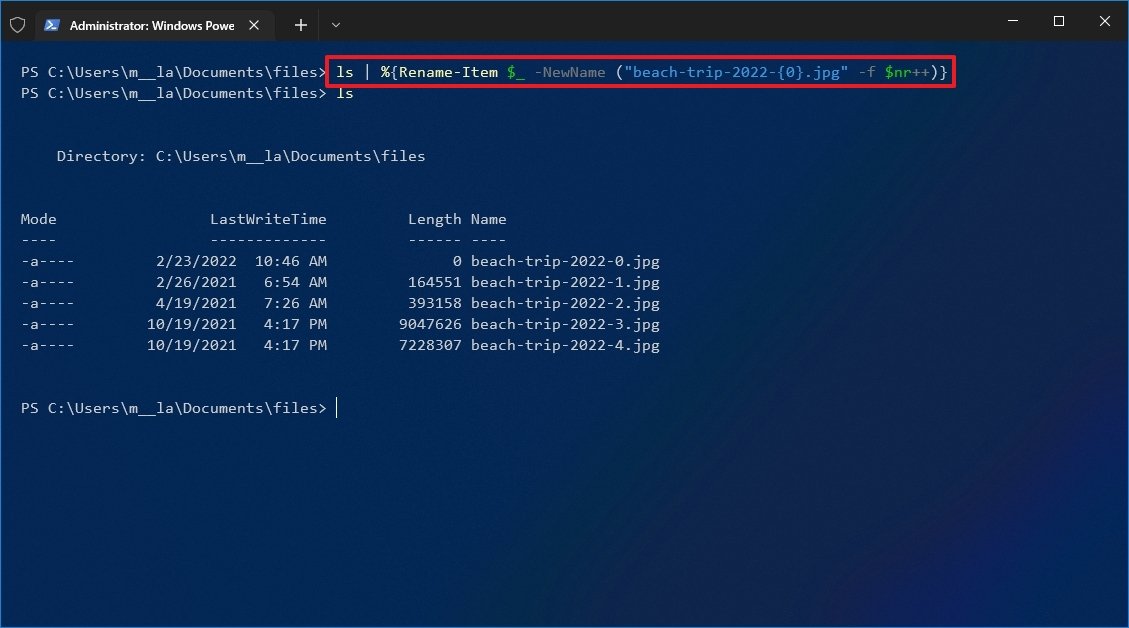 Source: Windows Central

After y'all complete these steps, the files with the specified format will be renamed using the naming structure available with the control.
Trim multiple file names
To make file names shorter, or trim part of the names by an "Northward" number of characters, use these steps:
- Open Start.
- Search for PowerShell and click the pinnacle result to open the app.
-
Type the following command example to navigate the folder with the files to rename and press Enter:
cd PATH\TO\BinderIn the control, supervene upon
PATH\TO\Folderwith the actual path to the location.For instance, this command navigates the "files" folder within "Documents":
cd C:\Users\USERNAME\Documents\files -
(Optional) Type the following control to view the files in the location and press Enter:
ls -
Blazon the following command to rename files using shorter names and press Enter:
ls | Rename-Item -NewName {$_.proper noun.substring(0,$_.BaseName.length-N) + $_.Extension}In the command, inside "$_.BaseName.length-N" update the value of "N" to specify the number of characters to remove.
For case, this command trims the name of your files by viii characters:
ls | Rename-Item -NewName {$_.name.substring(0,$_.BaseName.length-8) + $_.Extension}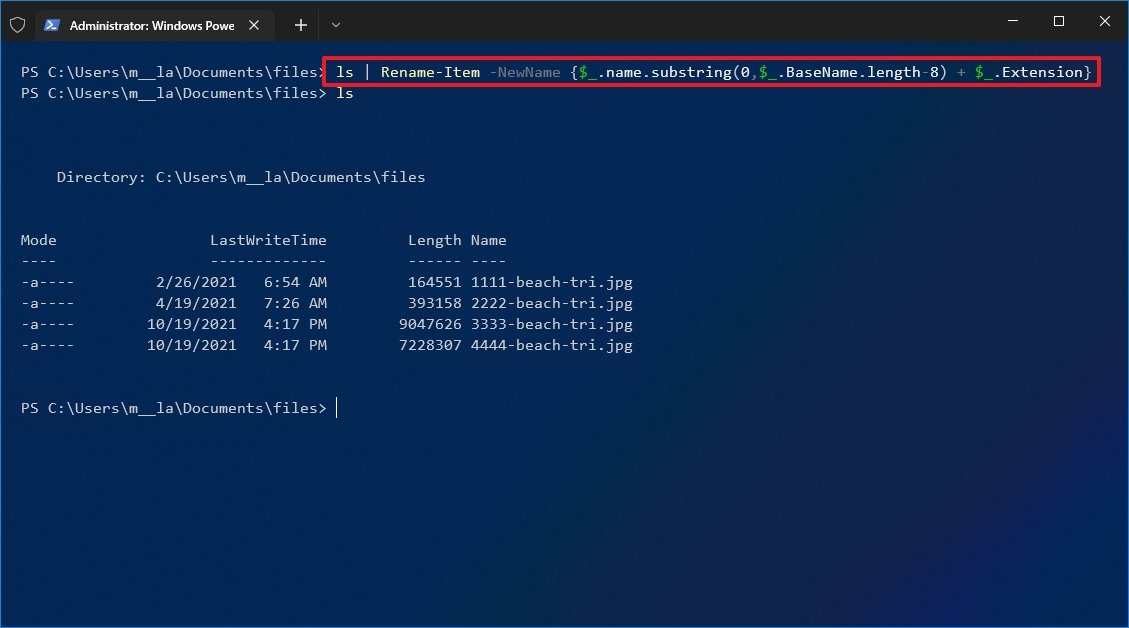 Source: Windows Central

Once y'all complete these steps, the files in the location volition at present take shorter names (correct to left), depending on the length specified in the command.
Delete office of the name from multiple files
To remove role of the file name on multiple files with PowerShell commands, utilize these steps:
- Open First.
- Search for PowerShell and click the summit result to open up the app.
-
Type the following control case to navigate to the files to rename and printing Enter:
cd PATH\TO\BinderIn the command, supplant
PATH\TO\FOLDERwith the actual path to the location.For instance, this command navigates the "files" folder inside "Documents":
cd C:\Users\USERNAME\Documents\files -
(Optional) Blazon the post-obit command to view the files in the location and press Enter:
ls -
Blazon the post-obit control to remove function of the file name and printing Enter:
ls | Rename-Item -NewName {$_.proper noun -replace "Quondam-FILE-Name-Function",""}In the command, replace "Onetime-FILE-Proper name-PART" with the actual role of the name yous desire to replace.
For instance, this command removes the word "trip" from the proper noun of all files in the folder:
ls | Rename-Detail -NewName {$_.name -replace "tri",""}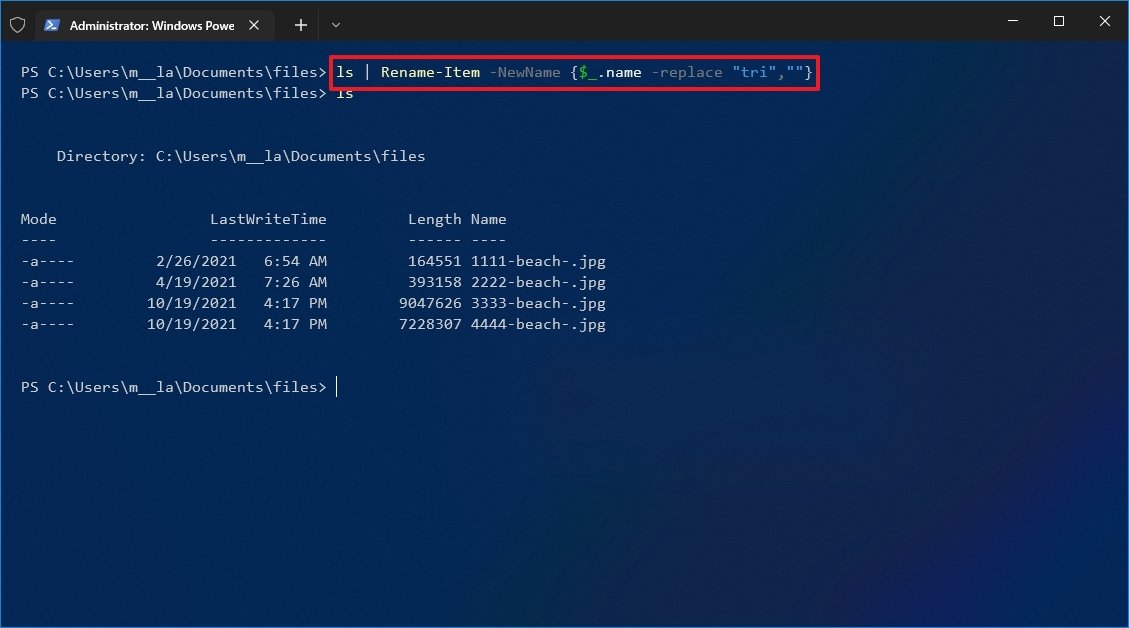 Source: Windows Central

After you complete the steps, the command will remove the file proper name part equally specified in the command.
Replace part of the proper name from multiple files
To rename the aforementioned role of the file proper noun, utilize these steps:
- Open Showtime.
- Search for PowerShell and click the tiptop issue to open the app.
-
Type the following control example to navigate to the folder with the files to rename and press Enter:
cd PATH\TO\BinderIn the control, replace
PATH\TO\Binderwith the actual path to the location.For example, this command navigates the "files" folder within "Documents":
cd C:\Users\USERNAME\Documents\files -
(Optional) Type the following command to view a list of the files in the location and press Enter:
ls -
Type the post-obit command to replace part of file name and press Enter:
ls | Rename-Item -NewName {$_.name -supersede "OLD-FILE-NAME-PART","NEW-FILE-NAME-Role"}In the command, supercede "OLD-FILE-Name-Role" and "NEW-FILE-Proper noun-Office" with the former and new part of the file proper name.
For example, this command replaces the word "vacation_" for "hiking_trip_" in the file proper name:
ls | Rename-Item -NewName {$_.name -replace "embankment-","hiking_trip_"}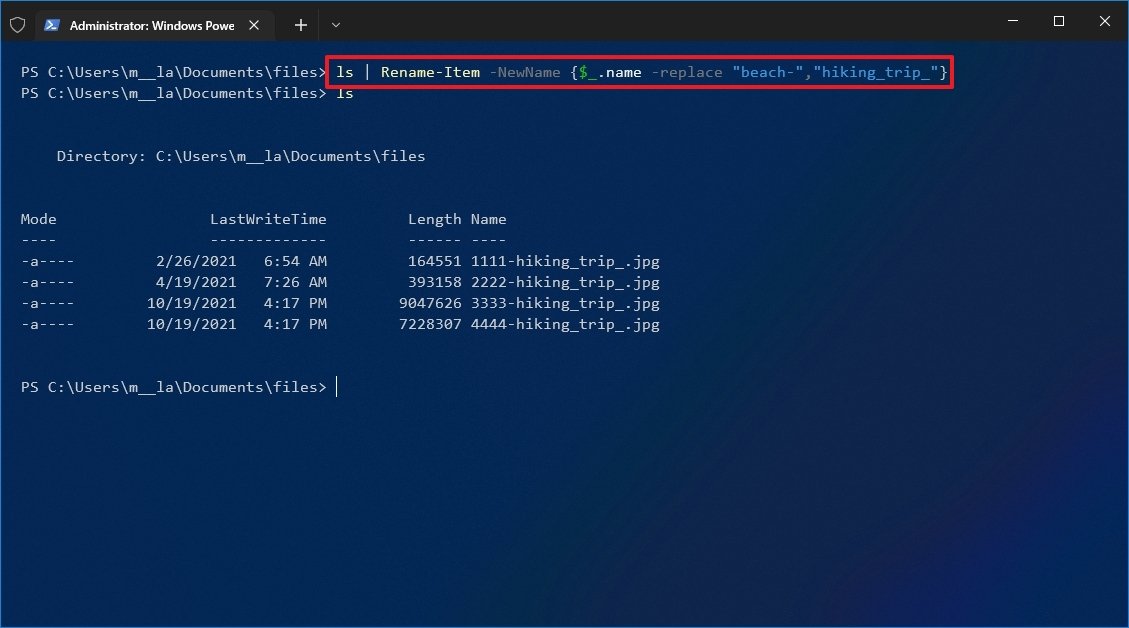 Source: Windows Central

Once you complete these steps, the command volition modify the file names with the replacement y'all specified in the command.
Remove spaces from multiple files
Spaces as function of the file name tin sometimes cause issues, even moreso when using commands. If you have files containing spaces in their names, y'all can use PowerShell to supersede the character for a visual separator, such as a dash or underscore symbol.
To remove and supervene upon spaces with underscores in filenames with PowerShell, use these steps:
- Open Start.
- Search for PowerShell and click the tiptop result to open the app.
-
Blazon the following command example to navigate to the folder with the files to rename and press Enter:
cd PATH\TO\FOLDERIn the command, replace
PATH\TO\FOLDERwith the actual path to the location.For example, this control navigates the "files" folder inside "Documents":
cd C:\Users\USERNAME\Documents\files -
(Optional) Type the post-obit command to view the files in the location and press Enter:
ls -
Type the following control to remove spaces from file name and press Enter:
ls | Rename-Particular -NewName { $_.Name -supervene upon " ","SEPARATOR" }In the command, make sure to replace "SEPARATOR" with the symbol instead of a space.
For example, this command replaces spaces with underscores in the files:
ls | Rename-Item -NewName { $_.Proper noun -replace " ","_" }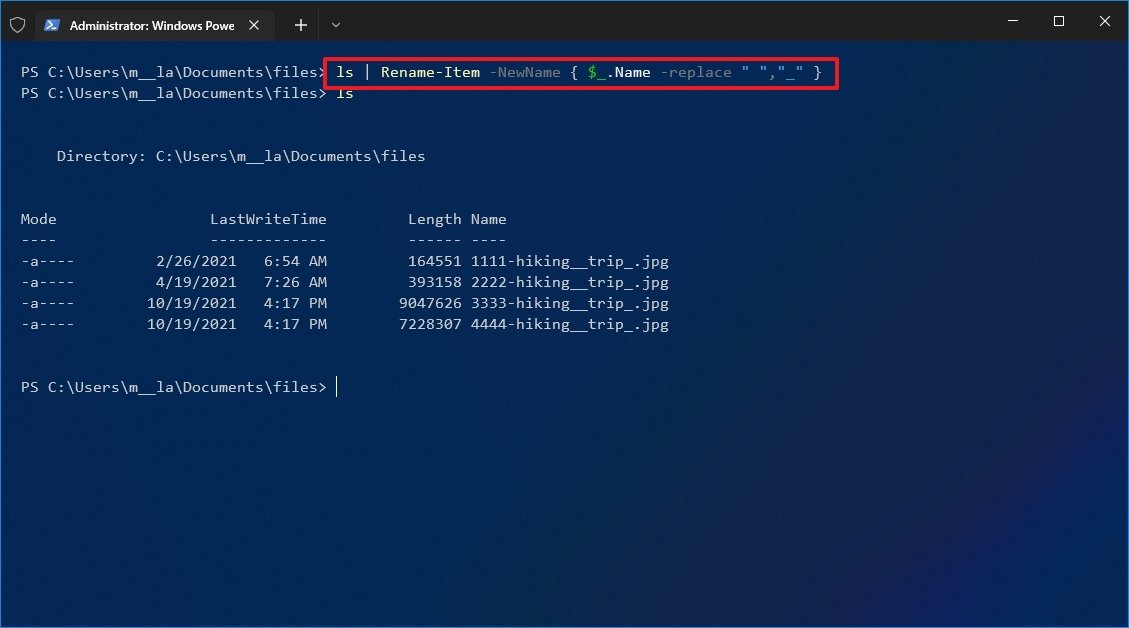 Source: Windows Fundamental

Later you lot complete the steps, the spaces will be replaced with the separator indicated in the control.
Change file extension
To change the file extension for a agglomeration of files with PowerShell, use these steps:
- Open Start.
- Search for PowerShell and click the top result to open the app.
-
Blazon the following command example to navigate to the binder with the files to rename and printing Enter:
cd PATH\TO\FOLDERIn the command, supplant
PATH\TO\Binderwith the bodily path to the location.For example, this command navigates the "files" folder inside "Documents":
cd C:\Users\USERNAME\Documents\files -
(Optional) Type the following command to view the files in the location and press Enter:
ls -
Type the post-obit control to change the extension on files and press Enter:
ls | Rename-Item -NewName { [io.path]::ChangeExtension($_.proper noun, ".NEW-EXTENSION") }In the command, supervene upon ".NEW-EXTENSION" with a new file extension.
For case, this command changes any file extension to ".medico":
ls | Rename-Item -NewName { [io.path]::ChangeExtension($_.name, "medico") }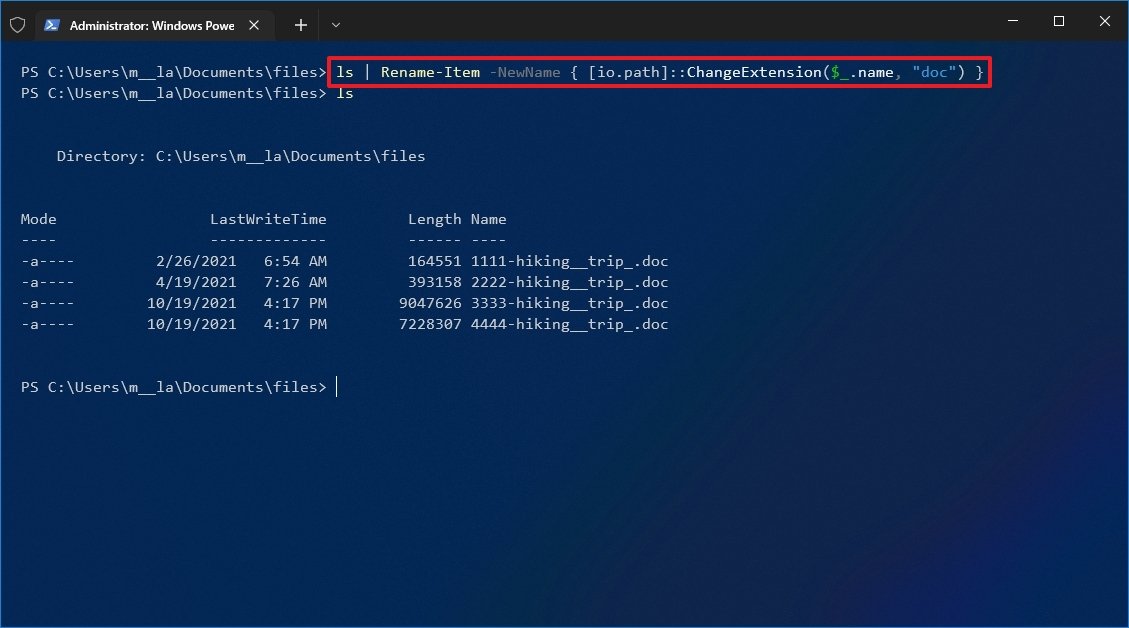 Source: Windows Central

One time you lot complete the steps, PowerShell volition change the extension for the files in the folder location.
Rename specific extension file names
The above instructions will rename every file inside the folder. However, if y'all want to change the name of a particular file format, such equally documents, pictures, or videos, you lot can apply the "-filter" option.
To change the names of a specific file format with PowerShell commands on Windows x, use these steps:
- Open Outset.
- Search for PowerShell and click the top result to open the app.
-
Type the post-obit command case to navigate to the folder with the files to rename and press Enter:
cd PATH\TO\FOLDERIn the control, supercede
PATH\TO\FOLDERwith the actual path to the location.For case, this command navigates the "files" folder inside "Documents":
cd C:\Users\USERNAME\Documents\files -
(Optional) Type the following command to view the files in the location and press Enter:
ls -
Type the post-obit control to rename files with a specific extension and press Enter:
ls -filter *.EXTENSION | %{Rename-Item $_ -NewName ("NEW-FILE-Proper name-{0}.EXTENSION" -f $nr++)}In the control, supersede "NEW-FILE-Proper noun" and "EXTENSION" with the new parameter.
For instance, this command renames only files that include the ".jpg" extension:
ls -filter *.jpg | %{Rename-Item $_ -NewName ("beach-trip-{0}.jpg" -f $nr++)} Source: Windows Cardinal

In one case you complete the steps, PowerShell will rename the files with a specific extension specified in the command.
While these commands have been tested to piece of work every bit expected, it is always recommended that you perform a test run before renaming the original files on your estimator.
How to rename multiple files using PowerToys
On Windows 11, PowerToys is an avant-garde tool that adds many helpful productivity tools, including "PowerRename," which makes it easier to bulk rename files without using commands.
Install PowerToys
To install PowerToys on Windows x, use these steps:
- Open the PowerToys app folio.
-
Click the Install button.
 Source: Windows Central
 - Open the PowerToys app.
- Click on PowerRename.
-
Turn on the Enable PowerRename toggle switch.
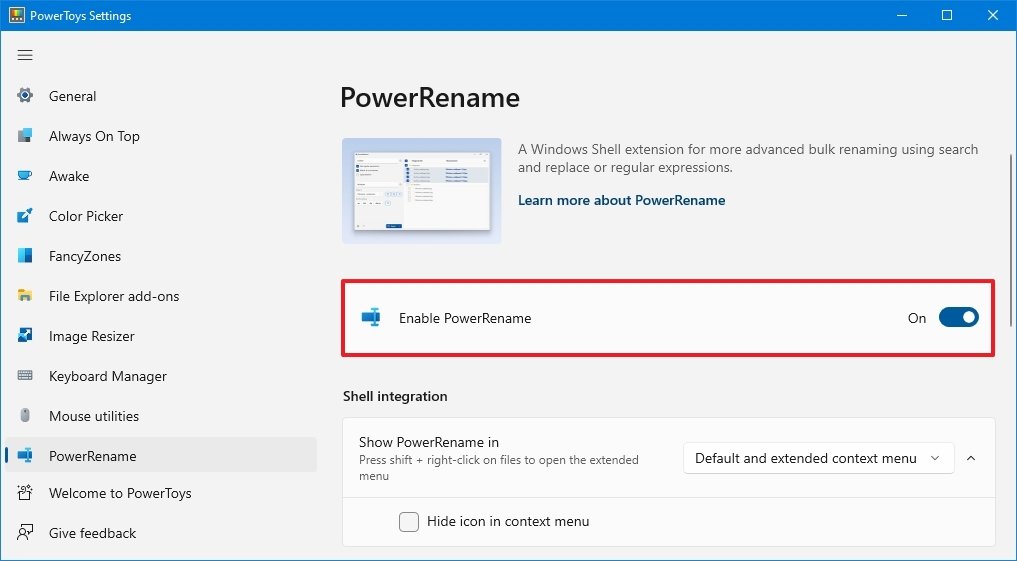 Source: Windows Key


After you complete the steps, you can first using the tool to rename multiple files.
Rename files past matching partial name
To rename or replace part of the proper noun of multiple files, use these steps:
- Open File Explorer.
- Navigate to the folder with the files to rename.
- Select the files to rename.
-
Right-click the selection and cull the PowerRename option.
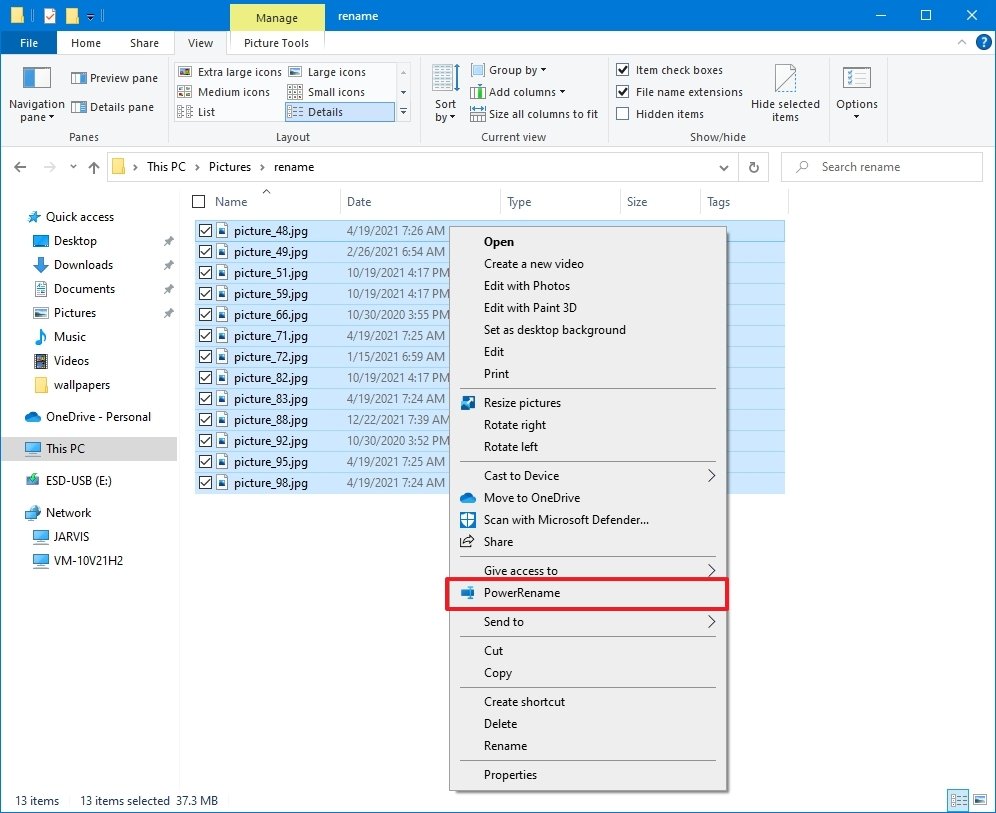 Source: Windows Primal
 - In the "Search for" box, define the role to rename.
-
In the "Replace with" box, specify the proper name structure yous desire to use for the files.
 Source: Windows Fundamental
 - Use the "Apply to" menu to ostend the office of the file name to change — for instance, filename, extension, or both.
- Choose the content to rename, including files, folders, and subfolders with the buttons on the right side.
- (Optional) Choose the text formatting, including lowercase, uppercase, championship instance, or capitalize every discussion.
- (Optional) Choose the "Enumerate items" selection to allow the files to have the same name only with a different number at the end.
- Confirm the preview on the right side.
- Click the Apply button.


Once you complete the steps, the files will be renamed according to your configuration.
Rename files past matching whatsoever name
To rename all the files without a mutual structure, use the steps:
- Open up File Explorer.
- Navigate to the folder with the files to rename.
- Select the files to rename.
-
Right-click the option and choose the PowerRename option.
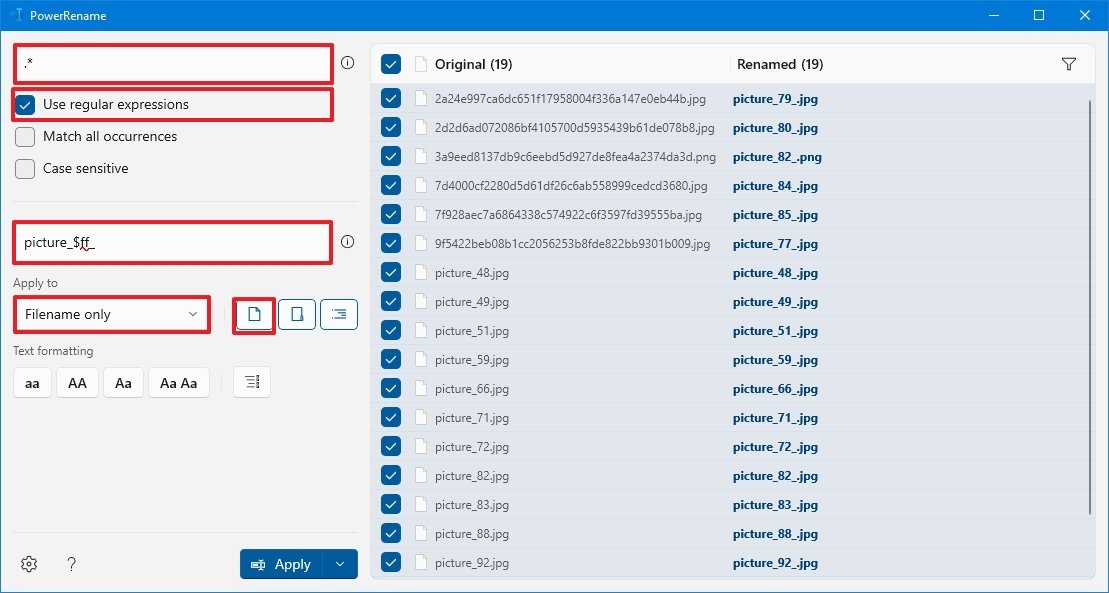
Source: Windows Central - In the "Search for" box, use the
.*regular expression to match all the files. -
Cheque the Employ regular expressions option.
 Source: Windows Central
 - In the "Supersede with" box, specify the name construction you want to use for the files.
- Click the "File creation date and time help" push on the right side and select a aid to enumerate the files since they volition have the same base proper name – for instance, "$ff" to add two millisecond digits.
- Use the "Apply to" menu select the Filename only selection.
- Cull the content to rename, including files, folders, and subfolders with the buttons on the right side.
- (Optional) Cull the text formatting, including lowercase, majuscule, title case, or capitalize every word.
- (Optional) Choose the "Enumerate items" option to allow the files to accept the same proper noun simply with a dissimilar number at the cease.
- Ostend the preview on the right side.
- Click the Apply push button.

Later you lot consummate the steps, all the files in the list will exist renamed to the base proper name you lot assigned them.
Rename files by appending description
To suspend a description to the file proper name, utilize the steps:
- Open File Explorer.
- Navigate to the folder with the files to rename.
- Select the files to rename.
-
Right-click the pick and choose the PowerRename option.
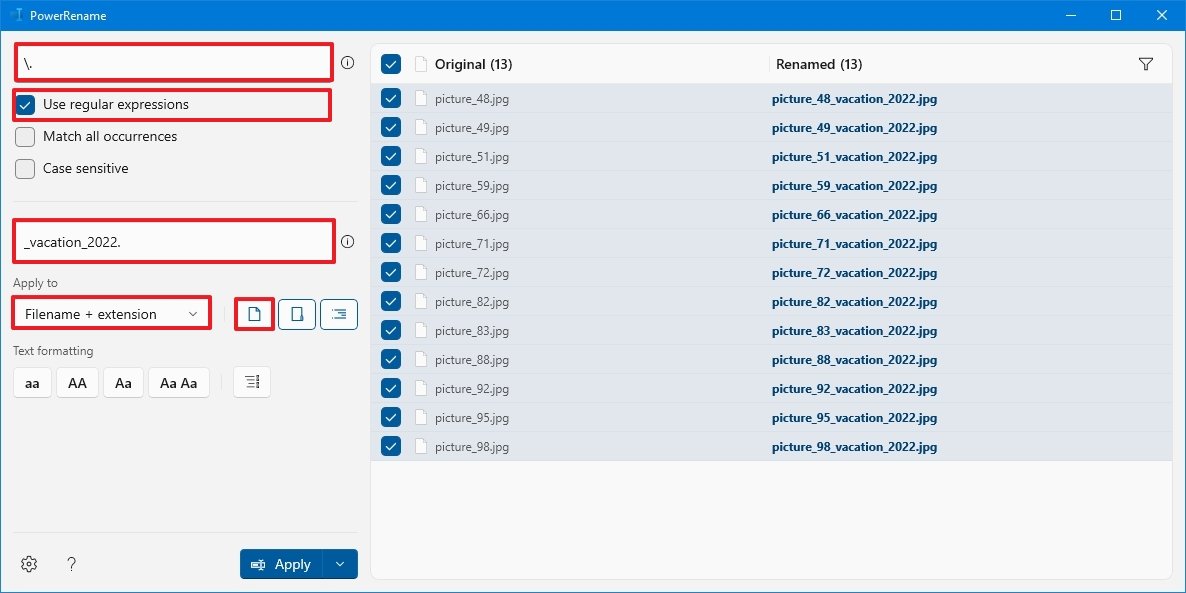
Source: Windows Central - In the "Search for" box, use the
\.regular expression to match all the files. - Bank check the Use regular expressions option.
-
In the "Replace with" box, specify the clarification you want to add together to files — for example, _vacation_2022.
 Source: Windows Primal
 Quick annotation: If you lot utilize this option, recollect the period at the stop of the description to prevent breaking the file extension.
- Use the "Apply to" menu to the Filename + extension option.
- Choose the content to rename, including files, folders, and subfolders with the buttons on the right side.
- (Optional) Choose the text formatting, including lowercase, upper-case letter, title case, or capitalize every discussion.
- (Optional) Choose the "Enumerate items" option to let the files to have the same name just with a different number at the stop.
- Ostend the preview on the right side.
- Click the Apply push.

Modify file extension
To change the file extension of multiple files with PowerToys, apply these steps:
- Open File Explorer.
- Navigate to the folder with the files to rename.
- Select the files to rename.
-
Right-click the selection and choose the PowerRename option.
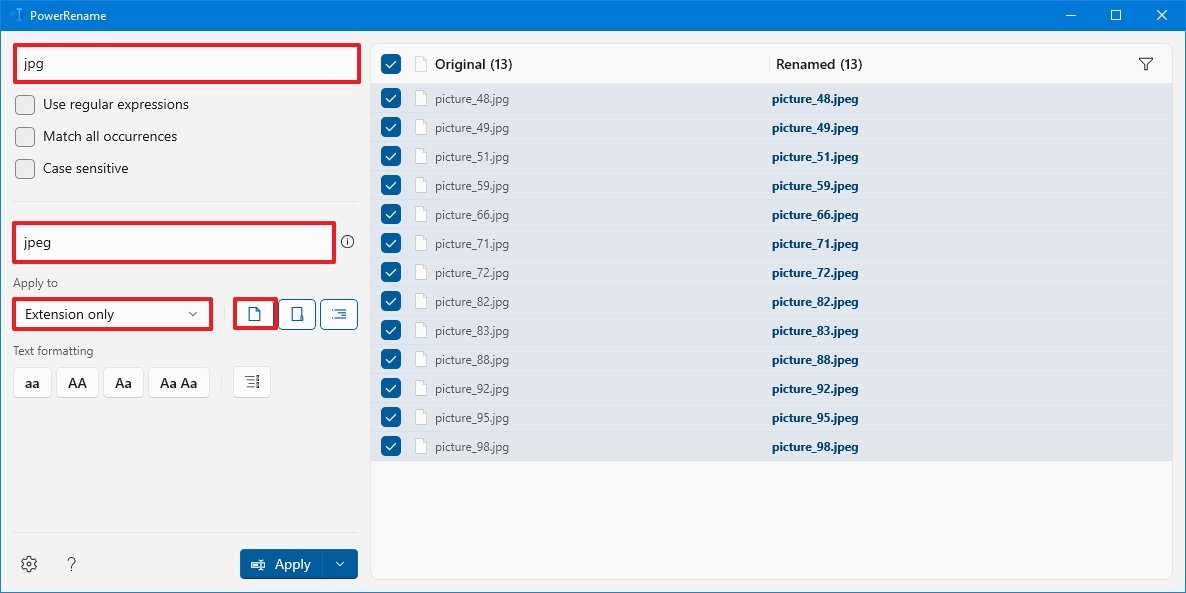
Source: Windows Cardinal - In the "Search for" box, confirm the extension to replace — for example, jpg.
-
In the "Replace with" box, confirm the new compatible extension — for example, jpeg.
 Source: Windows Central
 - Utilise the "Apply to" menu to select the Extension but option.
- Choose but the Include files option with the buttons on the right side.
- Click the Apply button.

Once you complete the steps, the file extension will change to the one y'all specified.
PowerToys PowerRename is a powerful tool that lets you dispense file names nearly in whatever manner y'all desire using regular expressions. You can larn more near the options available to create patterns to rename files in this Microsoft documentation folio.
More Windows resources
For more helpful articles, coverage, and answers to common questions most Windows 10 and Windows 11, visit the post-obit resources:
- Windows eleven on Windows Cardinal — All yous need to know
- Windows 11 help, tips, and tricks
- Windows 10 on Windows Key — All y'all need to know
Nosotros may earn a commission for purchases using our links. Learn more.

Room to abound
Hither's how Forza Horizon 5 could be even better
Forza Horizon v is i of the best games of 2021, and 1 of the greatest racing games you can play. It's certainly not perfect, though, with plenty of areas with room for improvement. Here are five things Forza Horizon 5 could do amend.

Fun in the snow
Review: Shredders on Xbox is a dear letter to snowboarding
Shredders is an Xbox console exclusive launching twenty-four hour period and engagement into Xbox Game Pass, and lets players alive out their greatest fantasies of being a professional snowboarder. Despite some performance bug, Shredders largely succeeds at enabling epic fun in the snow.
Source: https://www.windowscentral.com/how-rename-multiple-files-bulk-windows-10
0 Response to "How to Make an Upload Script That Renames Files to Numbers"
Postar um comentário